Introduction: Why Are People Returning to Traditional Herbal Hair Care?
Hair care is an important part of our daily routine. Everyone wants clean, healthy-looking, manageable hair and a comfortable scalp. However, choosing the right hair-care product is not always easy.
Today, customers can choose from hundreds of shampoos, conditioners, hair masks, oils and scalp-care products. Some people prefer conventional shampoos because they are convenient and easy to use. Others are interested in traditional herbal ingredients and simpler hair-care routines.
This growing interest has brought attention to herbal hair wash powders.
Herbal hair wash powder is a dry mixture of selected plant-based ingredients that customers prepare with water before applying to their hair and scalp.
Unlike conventional liquid shampoos, these products are generally supplied without water. Their cleansing properties depend on the botanical ingredients used, their quality and how the product is prepared.
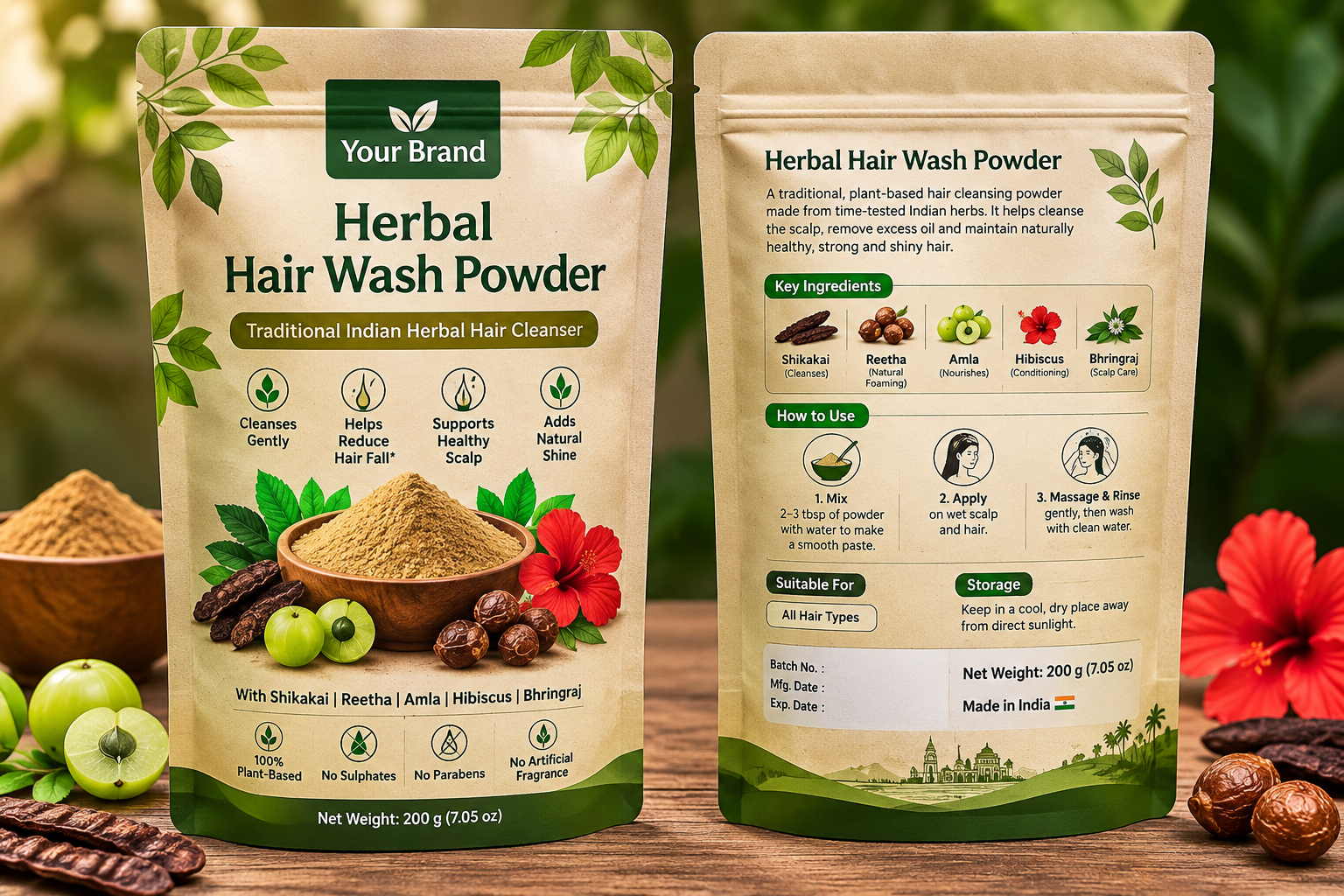
Traditional Indian hair-care practices have long included ingredients such as Shikakai, Reetha, Amla, Hibiscus and Bhringraj.
Each ingredient has different characteristics. Some contribute natural cleansing compounds, while others are traditionally valued for their role in hair care.
However, one important question remains:
Can traditional herbal ingredients provide a practical hair-washing experience for modern consumers?
The answer depends on much more than simply mixing herbal powders.
A successful herbal hair wash must clean effectively, spread comfortably, rinse properly and remain safe and consistent throughout its shelf life.
This article explains the ingredients, their functions, preparation methods, practical advantages, limitations and important considerations when choosing a herbal hair wash powder.
.png)
What Is Herbal Hair Wash Powder?
Herbal hair wash powder is a dry hair-cleansing preparation made using selected botanical ingredients.
The powder is mixed with water before use to form a paste or suspension that can be applied to damp hair and scalp.
Some herbal powders contain naturally occurring surface-active compounds called saponins.
Saponins can help water interact with oily substances and contribute to cleansing.
However, not every herbal ingredient acts as a cleanser.
Some ingredients are included for their traditional hair-care applications, while others may influence the texture, colour, consistency or feel of the prepared mixture.
The final performance depends on the complete formulation rather than any single ingredient.
How Is It Different From Regular Shampoo?
Most conventional liquid shampoos contain water, cleansing agents and other ingredients selected to achieve a particular performance.
They are generally ready to use directly from the bottle.
Herbal hair wash powders require preparation before application.
Customers usually mix the powder with water and apply the freshly prepared mixture.
This creates a different user experience.
A liquid shampoo offers convenience, while a herbal powder may appeal to customers who prefer traditional botanical ingredients.
Neither format is automatically better.
The right choice depends on the customer's hair type, scalp condition, cleansing requirements and personal preferences.
Understanding the Five Traditional Herbal Ingredients
A herbal hair wash can combine several botanical ingredients with different functions.
Five well-known ingredients in traditional Indian hair care are Shikakai, Reetha, Amla, Hibiscus and Bhringraj.
Understanding their individual roles helps customers develop realistic expectations.
Shikakai: A Traditional Botanical Cleanser
Shikakai is obtained from the fruit pods of Acacia concinna.
It has been used traditionally in India for washing hair.
Its importance comes partly from naturally occurring saponins.
These compounds can contribute to cleansing by helping water interact with oily substances.
Shikakai is therefore a useful ingredient to investigate when developing a botanical hair cleanser.
However, its actual cleansing performance depends on the quality of the raw material and how effectively its cleansing compounds become available during washing.
Different suppliers may provide powders with different particle sizes, processing methods and compositions.
For this reason, a product containing Shikakai should be evaluated through actual hair-washing tests rather than judged only by the ingredient name.
Reetha: The Traditional Soapnut
Reetha, commonly called soapnut, is another botanical ingredient associated with cleansing.
The fruit pericarp of Sapindus mukorossi contains saponins that contribute surface-active properties.
When suitable Reetha material is mixed with water, some of these compounds can be extracted.
This is why Reetha has traditionally been used in cleansing preparations.
However, consumers should understand that foam is not the only indicator of cleaning performance.
A product producing more foam is not necessarily removing more oil or dirt.
Reetha-containing preparations can also cause eye irritation, so contact with the eyes should be avoided.
A well-developed herbal hair wash should balance cleansing effectiveness with comfort and ease of rinsing.
Amla: A Traditional Hair-Care Ingredient
Amla, also known as Indian gooseberry, comes from Phyllanthus emblica.
It is widely recognized in traditional Indian hair-care practices.
Amla contains various naturally occurring compounds, including organic acids and polyphenols.
In a herbal hair wash, Amla may influence the acidity and other characteristics of the prepared mixture.
However, the final pH cannot be predicted accurately from the presence of Amla alone.
It depends on the complete formulation and the water used during preparation.
Although Amla is traditionally associated with hair care, claims such as guaranteed hair growth or permanent prevention of hair fall require appropriate scientific evidence.
Consumers should therefore view Amla as a botanical hair-care ingredient rather than a proven medical treatment.
Hibiscus: A Botanical Ingredient Associated with Hair Care
Hibiscus is another familiar ingredient in traditional hair-care preparations.
Hibiscus flower contains plant components that may influence the texture of mixtures prepared with water.
Research on extracted Hibiscus mucilage has demonstrated properties relevant to thickening and binding applications.
However, whole Hibiscus flower powder is not the same as purified Hibiscus mucilage.
The behaviour of whole flower powder depends on its composition, processing and particle size.
In herbal hair wash products, Hibiscus may contribute to the overall paste characteristics.
Whether it improves softness, spreading or rinsing must be established through testing of the finished product.
Bhringraj: A Traditional Botanical Hair-Care Ingredient
Bhringraj, botanically identified as Eclipta prostrata, is widely known in traditional Indian hair care.
It is frequently used in herbal hair oils and other botanical preparations.
Its traditional reputation has made it a familiar ingredient among customers interested in plant-based hair care.
For example, evidence from laboratory studies or studies using concentrated extracts cannot automatically establish that whole Bhringraj powder will produce the same effects when briefly applied and rinsed away.
In a herbal hair wash, Bhringraj contributes to the botanical product concept.
Its specific benefits must be assessed in the context of the complete product.
How to Use Herbal Hair Wash Powder
Herbal hair wash powder generally requires preparation before use.
The exact directions depend on the formulation and should be established through product testing.
For a product designed to form a fresh herbal paste, the general preparation process may involve the following steps.
Step 1: Prepare a Clean Bowl
Use a clean bowl suitable for mixing the powder with water.
A spoon can be used for stirring.
The bowl should be free from leftover cosmetic products, oils and other contaminants.
Step 2: Add Clean Water
Pour the amount of water recommended on the product label into the bowl.
Lukewarm water may be suitable for some formulations.
However, excessively hot water should be avoided unless the manufacturer has specifically validated a heated preparation method.
Step 3: Add the Powder Gradually
Sprinkle the herbal powder into the water while stirring.
Adding the entire quantity at once may produce dry lumps.
Gradual addition can help the powder become evenly wetted.
Step 4: Mix Thoroughly
Continue stirring until the powder forms a reasonably uniform paste.
Because botanical powders contain insoluble plant material, the mixture may not dissolve completely.
A smooth-looking suspension or paste is a more realistic expectation than a transparent liquid.
Step 5: Allow Hydration if Required
Some formulations may benefit from a short resting period after mixing.
This allows water to penetrate the botanical particles and may change the consistency.
However, the required hydration time should be determined by testing.
Longer resting periods are not automatically better.
Step 6: Apply to Damp Hair and Scalp
Apply the freshly prepared mixture according to the manufacturer's directions.
Spread it gently and avoid vigorous rubbing.
Hair is more vulnerable to mechanical damage when wet, so unnecessary friction and pulling should be avoided.
Step 7: Rinse Thoroughly
Rinse the hair and scalp with clean water until visible powder residue is removed.
Particular attention may be required for long, curly or dense hair.
Do not leave the mixture on the scalp longer than the validated contact time.
The final consumer instructions should clearly explain preparation, application, contact time and rinsing.
Can Traditional Indian Herbal Hair Care Become a Successful Export Business?
India has a long history of using natural ingredients for personal care. Shikakai, Reetha, Amla, Hibiscus and Bhringraj are familiar names in traditional Indian hair-care practices.
For generations, these ingredients have been used in different preparations for washing and caring for hair.
Today, they also offer an interesting opportunity for Indian manufacturers, merchant exporters and private-label businesses.
International buyers expect products that meet their market requirements.
They consider product quality, safety, packaging, labeling, regulatory compliance, pricing, consumer demand and reliable supply.
This creates an important question for Indian exporters:
Can a traditional herbal hair wash product be developed into a commercially successful international cosmetic product?
The answer depends on selecting the right market, understanding the buyer's requirements and developing a product that delivers a practical customer experience.
Why India Has an Opportunity in Herbal Hair-Care Exports
India offers several advantages for businesses developing botanical personal-care products.
One advantage is familiarity with traditional herbal ingredients.
Another is the availability of botanical raw-material suppliers, cosmetic manufacturers and private-label manufacturing services.
India also has established international trade relationships in cosmetics and personal-care products.
India has a long tradition of using botanical ingredients such as Shikakai, Reetha, Amla, Hibiscus and Bhringraj in hair-care preparations. Today, Indian manufacturers have an opportunity to transform these familiar ingredients into modern herbal hair wash products designed for international markets.
For importers, the opportunity is not limited to purchasing traditional herbal powders. It also includes developing convenient, professionally packaged and quality-tested botanical hair-care products that can be introduced under existing brands or through private-label arrangements.
India's Existing Hair-Care Export Trade
According to World Integrated Trade Solution data based on international merchandise trade reporting, India exported approximately USD 198.5 million worth of products under HS heading 3305 in 2024.
This heading covers preparations for use on the hair.
It includes different types of hair-care products, not exclusively herbal hair wash powders.
The figures demonstrate that India already participates in international hair-care trade.
They do not establish the market size or demand for the particular herbal product discussed in this article.
What Does This Mean for a New Exporter?
A new exporter should use trade data to identify markets worth investigating.
The next step is to verify actual demand for the specific product.
This requires discussions with importers, distributors and potential private-label customers.
Export decisions should be based on confirmed commercial requirements rather than attractive market statistics alone.
Indian manufacturers can explore product development using traditional botanical ingredients while incorporating modern quality-control practices.
For international importers, the most attractive opportunities may include:
- Botanical product positioning: Hair-care products featuring familiar Indian ingredients such as Shikakai, Reetha and Amla.
- Private-label manufacturing: Products developed and packaged under an international buyer's brand.
- Customized packaging: Single-use sachets, multi-use pouches and retail-ready cartons.
- Product innovation: Improved mixing, smoother application and easier rinsing, subject to performance testing.
- Traceable sourcing: Botanical ingredients supported by suitable identity and quality documentation.
- Quality-focused manufacturing: Product development supported by relevant safety, microbiological and stability testing.
These features can help importers develop differentiated product offerings, provided the finished products meet the regulatory and commercial requirements of their destination markets.
United Arab Emirates: A Potential Market for Indian Herbal Hair Care
The United Arab Emirates is an important destination for India's hair-preparation exports.
It has established retail, wholesale and distribution channels for imported cosmetics.
For an Indian exporter, the UAE may be worth investigating because it offers access to consumers from different backgrounds, including people familiar with Indian personal-care traditions.
Who Could Import Herbal Hair Wash Powder?
Potential buyers include cosmetics importers, personal-care distributors, beauty-product wholesalers, ethnic-product retailers and private-label brand owners.
Each buyer category has different expectations.
A distributor may want an established retail-ready product.
A private-label company may want the Indian manufacturer to produce goods under its own brand.
A wholesaler may prioritize pricing, packaging and repeat supply.
What Should Indian Exporters Investigate?
Before sending quotations, exporters should understand the buyer's intended sales channel.
For example, a product intended for a premium beauty retailer may require different packaging from one intended for traditional grocery and personal-care outlets.
Arabic labeling and local product-registration requirements also need attention.
Cosmetic product registration and market access can depend on the relevant UAE authority and the emirate or sales channel involved.
Exporters should confirm the applicable requirements with the importer and competent authorities before shipment.
Practical Export Strategy
An Indian exporter can begin by identifying UAE distributors already handling Indian herbal cosmetics.
Instead of sending a general product catalogue, the exporter should explain the product's intended use, packaging format, manufacturing capabilities and available quality documentation.
The buyer should then be asked whether the product fits an existing customer requirement.
This approach is more useful than assuming that all Indian herbal products will sell successfully in Dubai.
Nepal: A Practical Market to Investigate for Indian Exporters
Nepal is another important destination for India's hair-preparation exports.
Geographic proximity is a significant advantage.
India and Nepal have established cross-border trading relationships, and Indian consumer products are already familiar in the Nepalese market.
For a new exporter, Nepal may offer an opportunity to investigate relatively manageable shipment arrangements.
However, proximity does not remove the need for product registration, customs compliance or commercial planning.
Why Nepal Deserves Attention
One advantage is the possibility of arranging relatively small commercial shipments by road, subject to the logistics provider's services and the importer's requirements.
Another is the opportunity to communicate directly with distributors handling Indian consumer products.
A buyer importing ordinary shampoo may not necessarily be interested in a dry herbal preparation.
Potential Buyer Categories
Relevant buyer categories include cosmetics distributors, personal-care wholesalers, herbal-product distributors and retail chains.
Private-label businesses may also be worth investigating.
Regulatory Considerations
The product's classification and claims are particularly important.
A cosmetic hair wash and a product making medicinal treatment claims may face different regulatory requirements.
The Nepalese importer should confirm the applicable authority, product-registration requirements, labeling rules and necessary import permissions.
Indian exporters should not assume that a cosmetic product can enter Nepal without prior regulatory verification.
Practical Market-Entry Approach
Start by identifying importers already selling Indian hair-care products.
Study their existing product range.
Determine whether they sell herbal powders, liquid shampoos, hair masks or other botanical products.
Then contact them with a specific commercial proposal.
The first objective should be to understand the buyer's demand, target selling price and registration requirements.
Only after these details are clear should the exporter finalize the product quotation.
United States: Opportunities for Differentiated Herbal Hair Products
The United States is an important destination for Indian hair-care exports.
It also offers a wide range of consumer segments and retail channels.
Potential customers may include people interested in traditional Indian beauty practices, botanical personal care and alternative hair-cleansing formats.
Understanding the American Market
The United States has established conventional shampoo brands, specialist hair-care products and numerous independent beauty businesses.
A new Indian herbal hair wash must compete for consumer attention.
Potential Importers
Indian exporters can investigate specialty beauty distributors, Indian grocery and personal-care distributors, botanical-product brands, online retail businesses and private-label companies.
Different channels have different costs.
An online seller may need fulfillment arrangements, inventory planning, customer-service support and product-liability considerations.
A wholesale distributor may require consistent supply, commercial documentation and established product specifications.
United States Regulatory Considerations
Cosmetic products marketed in the United States are subject to applicable requirements under the Federal Food, Drug, and Cosmetic Act and other relevant legislation.
The Modernization of Cosmetics Regulation Act introduced additional requirements for many cosmetic businesses, including certain facility-registration, product-listing and safety-related obligations.
Applicability and exemptions must be assessed for the specific product and responsible business.
A cosmetic product generally should not be promoted as treating medical conditions without evaluating whether it becomes subject to drug regulation.
Claims about curing scalp diseases or stimulating hair regrowth can create significant regulatory concerns.
Practical Recommendation
For the United States, I would prioritize product differentiation, safety documentation and regulatory preparation before approaching large distributors.
A product that is commercially attractive but poorly documented may face difficulties during onboarding.
Saudi Arabia: An Important Destination for Indian Hair Preparations
Saudi Arabia is another established destination for Indian hair-preparation exports.
Its personal-care market includes imported products distributed through different retail and commercial channels.
For Indian exporters, the opportunity lies in identifying importers whose existing product portfolios match the proposed herbal hair wash.
Understanding Buyer Expectations
An importer may evaluate product appearance, packaging quality, consumer instructions, price and supporting documentation.
The exporter should also consider local language requirements and market-specific product claims.
Arabic labeling requirements must be verified.
Regulatory Requirements
Cosmetics marketed in Saudi Arabia are regulated under the applicable framework administered by the Saudi Food and Drug Authority.
Product notification or listing requirements, ingredient restrictions, labeling and responsible-party obligations must be reviewed for the specific product.
An exporter should coordinate with the Saudi importer before printing commercial packaging.
A product label prepared only for the Indian market may require changes.
Potential Buyers
Relevant buyers may include cosmetics importers, personal-care distributors, beauty-product wholesalers and private-label brand owners.
Exporters should identify businesses already handling imported botanical or herbal personal-care products.
Practical Export Strategy
I would begin with importers who already understand Indian-origin cosmetics.
The first discussion should focus on whether they have a customer segment for dry herbal hair wash products.
If the buyer is interested, request details about preferred packaging, registration responsibilities, order quantities and target pricing.
Avoid producing large quantities before these requirements are confirmed.
Indonesia: A Large Market with Important Regulatory Considerations
Indonesia is among the leading destinations for India's exports under the selected hair-preparation category.
It has a large domestic consumer market and established distribution channels for personal-care products.
Why Indonesia May Be Interesting
The market provides opportunities to investigate imported cosmetic products and differentiated botanical hair-care concepts.
However, an Indian exporter must establish whether consumers and distributors are interested in the proposed product format.
A dry powder requiring preparation may appeal to some customers but may be less convenient for others.
Consumer preferences should be validated through importer discussions and product testing.
Regulatory Considerations
Cosmetic products entering Indonesia generally require compliance with applicable requirements administered by BPOM, Indonesia's food and drug authority.
These can include product notification, ingredient compliance, labeling and local responsible-party requirements.
Halal-related obligations must also be reviewed under the applicable Indonesian framework and implementation timelines.
Exporters should not assume that an Indian cosmetic manufacturing license or a general quality certificate is sufficient for Indonesian market access.
Potential Importers
Relevant buyers include cosmetics importers, beauty-product distributors, private-label companies and businesses selling imported personal-care products.
Practical Recommendation
Before offering Indonesia as a target market, confirm the importer's ability to handle product notification and regulatory compliance.
The importer should also explain its intended sales channel and customer demand.
For a first-time exporter, regulatory preparation and reliable local cooperation may be more important than the size of the overall market.
Manufacturing Requirements for Export-Quality Herbal Hair Wash Powder
An export-quality product must provide consistent performance across production batches.
This is particularly important for herbal powders because botanical raw materials can vary.
Raw-Material Identity
Manufacturers should verify the botanical species and plant parts.
Different plant materials should not be substituted without assessment.
Particle-Size Control
Particle size influences mixing, texture, dust generation and rinsing.
The appropriate specification should be established through testing.
Moisture Control
Dry powders require protection against unwanted moisture.
Excessive moisture may affect storage stability and product quality.
Microbiological Quality
Botanical materials can carry microorganisms.
Manufacturers should establish suitable microbiological specifications and testing procedures.
Contaminant Testing
Risk-based testing may include heavy metals, pesticide residues and other relevant contaminants.
Stability Testing
The manufacturer should establish a justified shelf life using appropriate stability evidence.
Batch Traceability
Every commercial batch should be traceable to its raw materials, manufacturing records and quality results.
For international buyers, consistent quality and reliable documentation are often essential parts of supplier evaluation.
Packaging Opportunities for International Markets
Packaging affects consumer convenience, shipping efficiency and product positioning.
For herbal hair wash powder, moisture protection is especially important.
Single-Use Sachets
Single-use sachets may be suitable for trial packs and measured applications.
However, the quantity should be validated for the intended customer.
Multi-Use Pouches
Larger pouches may appeal to customers seeking repeated use.
They require suitable resealing and moisture protection.
Retail Cartons
Cartons containing multiple sachets may support organized retail presentation.
Private-Label Packaging
International buyers may request packaging under their own brand.
This can include customized artwork, languages, product instructions and regulatory information.
Export Packaging Considerations
The exporter should assess moisture protection, seal integrity, handling damage, carton strength and transport conditions.
A product that arrives with damaged seals or hardened powder may create complaints even if the formulation was originally acceptable.
Why Herbal Hair Wash Powder from India Is a Good B2C Business Opportunity
Herbal Hair Wash Powder from India offers international entrepreneurs an opportunity to build their own B2C brands through Amazon FBA and online stores. Its traditional botanical ingredients, lightweight dry format and repeat-purchase potential make it an attractive product to explore. Importers can introduce private-label products, trial packs, single-use sachets, starter kits and subscription plans. Compact packaging may help reduce shipping costs, while innovative product combinations can attract customers. With effective branding, competitive pricing and consistent quality, importers can differentiate themselves from conventional shampoo brands and develop a profitable, long-term herbal hair-care business in international markets.
Herbal Hair Wash Powder from India offers international entrepreneurs an opportunity to build profitable B2C brands through Amazon FBA and online stores. Its lightweight dry format, traditional botanical ingredients and repeat-purchase potential make it attractive for direct-to-consumer sales.
Practical B2C Product Formats:
- 50g Trial Packs: Affordable introduction for first-time customers.
- 100g–200g Pouches: Regular household use.
- Single-Use Sachets: Convenient for travel and measured applications.
- Starter Kits: Herbal powder with a reusable mixing bottle.
- Monthly Subscription Packs: Encourage repeat purchases.
- Family Multipacks: Larger quantities for regular customers.
- Premium Gift Sets: Attractive packaging for gifting.
These formats offer opportunities for private labeling, product differentiation, higher order values and long-term customer retention.
Practical Product Differentiation Ideas
- Easy-Mix Formula: Develop a powder that mixes quickly with water without excessive lumps.
- Easy-Rinse Technology: Optimize particle size to reduce herbal residue in hair.
- Hard-Water Tested: Test performance using water conditions common in target markets.
- Hair-Length-Based Packs: Offer different quantities for short, medium and long hair.
- QR-Code Tutorials: Provide preparation and application videos in local languages.
- Measured Mixing Bottles: Include water-level markings for convenient preparation.
- Humidity-Protected Packaging: Introduce moisture-resistant pouches for humid markets such as the UAE and Indonesia.
- Travel-Friendly Kits: Combine compact sachets with a reusable mixing accessory.
- Beginner-Friendly Kits: Include illustrated instructions for customers trying herbal hair wash for the first time.
- Customizable Private Labels: Offer different packaging, branding and product positioning for international markets.
B2C Advantage: These innovations can help importers differentiate their products, improve customer convenience, encourage repeat purchases and build a recognizable herbal hair-care brand.
Conclusion: The Future of Herbal Hair Wash Powder from India
Herbal Hair Wash Powder brings together India's traditional botanical hair-care knowledge and the growing opportunities for modern personal-care product development.
Ingredients such as Shikakai, Reetha, Amla, Hibiscus and Bhringraj have been familiar in Indian hair-care practices for generations. However, developing a successful commercial product requires more than combining traditional ingredients.
The finished product must provide satisfactory cleansing, comfortable application, easy rinsing, consistent quality and clear instructions for consumers.
For international importers, India offers opportunities to explore traditional botanical products in modern formats, including single-use sachets, multi-use pouches, retail cartons and private-label packaging.
Countries such as the United Arab Emirates, Nepal, the United States, Saudi Arabia and Indonesia provide potential markets for further investigation. However, exporters should first establish actual buyer demand, target pricing, product-registration requirements and the suitability of the product for local consumers.
Indian manufacturers and merchant exporters can create additional value by improving product preparation, controlling botanical raw-material quality, developing practical packaging and maintaining reliable manufacturing standards.
For international buyers, the opportunity is not simply to purchase another herbal powder from India. It is to introduce a carefully developed botanical hair-care product that combines traditional ingredients with modern customer expectations.
The future of Herbal Hair Wash Powder exports from India will depend on how successfully manufacturers transform traditional botanical knowledge into safe, reliable, convenient and commercially competitive products for international markets.
Start your Traditional Herbal Hair Care business and take them to international level today with expert support.
Chat with us directly on WhatsApp – [Click Here]
Discover more about us online – [Visit Now]
Tags: Import Herbal Hair Wash Powder from India Benefits Quality and Sourcing Guide