Introduction: The Expanding Global Appetite for Indian Dehydrated Onions
If you’re looking at importing dehydrated onions into Japan, you’ll want a partner you can count on for consistent quality, innovative formats and reliable supply. India is already one of the world’s largest exporters of dehydrated onion products — for example, over 84 destination countries and thousands of shipments in recent years. Among the top importing nations of Indian dehydrated onion are Indonesia, United States, Brazil, United Kingdom, Vietnam, Mexico, Netherlands, Germany and Bangladesh. Now Japan has the opportunity to benefit from this strong Indian supply chain and even step up with newness and premium features that many importers haven’t yet fully leveraged.
Unique Selling Propositions (USPs) of Indian Dehydrated Onions for Japan
India offers a series of distinct advantages for Japanese importers looking to diversify or upgrade their dehydrated onion supply chain:
- Diverse Formats: From flakes, kibbled, chopped, minced, to powder and granules, Indian suppliers can meet every specification required by Japanese food manufacturers.
- Robust Flavour Profile: Indian onions are renowned for their strong aroma and taste retention, due to high sulfur content and optimal dehydration processes.
- Low Moisture = Long Shelf Life: Most Indian dehydrated onions boast moisture levels below 6%, ideal for Japanese importers concerned about product longevity.
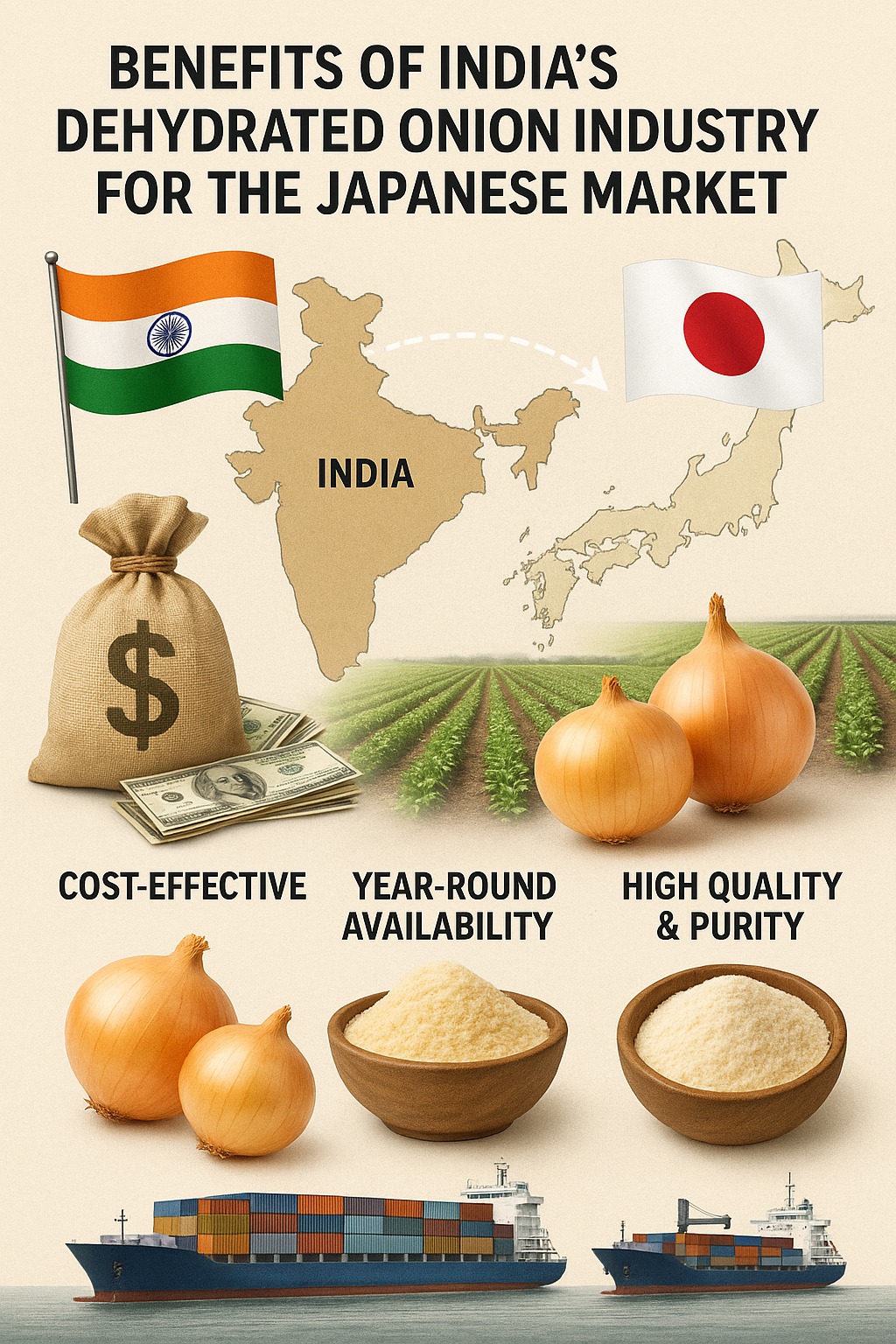
- Cost-Effective Logistics: Lightweight and non-refrigerated, dehydrated onions make shipping to Japan highly economical.
- Compliance Ready: HACCP, ISO-certified facilities in India are capable of meeting Japanese safety and hygiene standards.
- Sustainability and Traceability: Many Indian suppliers use clean energy and offer batch-level tracking, aligning with Japan’s sustainability values.
Top Varieties of Indian Dehydrated Onions and Their Sourcing Cities
- White Onion Flakes
- Specialty: Light colour, mild flavour, used in soups, sauces.
- Sourcing City: Mahuva, Gujarat
- Red Onion Kibbled
- Specialty: Rich colour, sweet flavour for gourmet applications.
- Sourcing City: Lasalgaon, Maharashtra
- Pink Onion Granules
- Specialty: Balanced pungency and colour; used in spice blends.
- Sourcing City: Bhavnagar, Gujarat
- Minced Dehydrated Onion (3-5mm)
- Specialty: Uniform cuts, quick hydration.
- Sourcing City: Jalgaon, Maharashtra
- Onion Powder (100-120 mesh)
- Specialty: For soups, ramen bases, snack seasonings.
- Sourcing City: Rajkot, Gujarat
.jpg)
Technical Specifications – What Japanese Importers Must Know
- Moisture Content: ≤ 6%
- Acid Insoluble Ash: ≤ 1.00%
- Total Ash: ≤ 5.00%
- Volatile Oil Content: Minimum 0.2 mL/100g
- Particle Size: Flakes (8-15mm), Chopped (3-5mm), Granules (0.5-1mm), Powder (100-120 mesh)
- HS Code: 07122000
- Certifications: FSSAI, HACCP, ISO 22000, FDA compliant
- Packaging: Poly-lined paper bags or cartons (14kg, 20kg, 25kg)
- Storage Requirements: Cool, dry warehouse with moisture control
.jpg)
The Step-by-Step Production Process in India
- Farm-Level Sourcing: High-sulfur onions harvested at full maturity
- Cleaning and Sorting: Dirt removal, grading by size and quality
- Peeling and Slicing: Based on final format (flakes, minced, etc.)
- Blanching (Optional): Enzyme deactivation to retain colour and reduce microbial load
- Dehydration: Hot air or belt dryers reduce moisture to ≤ 6%
- Cooling and Sieving: To reach ambient temperature and remove fines
- Milling/Grinding: For powders and granules
- Quality Testing: Lab checks for moisture, ash, oil content, microbiology
- Packing: In moisture-resistant, export-grade packaging
- Containerization: Optimised for 20ft (~8MT) and 40ft (~18MT) containers
- Export Documentation: IEC, Certificate of Origin, B/L, CoA, MSDS
- Shipping to Japan: Sea freight (FOB/CIF/DDP terms)
Innovation and Newness for the Japanese Market
- Customized Granule Size: For miso soups, instant ramen, and snack foods
- Toasted Variants: Ideal for sauces and condiments
- Organic and Non-GMO Options: Responds to Japan’s clean-label trend
- Pre-Blended Mixes: Onion-Garlic combos for seasoning producers
- Eco-Friendly Packaging: Biodegradable sacks and QR-coded traceability
- Low-Pungency Onions: For markets preferring milder aroma
- Private Labeling: For Japanese brands wanting to import under own name
Strategic Export Plan for Japanese Importers
- Initial Sampling and Customization: Small batch exports to align with Japanese specifications
- Brand Partnerships: Collaborate with Japanese seasoning, snack, and ready-meal companies
- Trade Shows and Buyer Events: Participate in FOODEX Japan and JETRO events
- Quality Assurance: Deploy Japanese-style TQM in production
- Seasonal Buffer Stock: Ensuring year-round availability
- Sustainability Labeling: Highlight eco-friendly processing for B2C appeal
Opportunities and Challenges
Opportunities:
- Large-scale, reliable Indian supply chain
- Japan's increasing demand for processed, shelf-stable ingredients
- Growth in private-label and premium product segments
Challenges:
- Strict Japanese food safety norms
- Need for rapid logistic turnaround
- Establishing brand trust among local buyers
Mitigation Strategies:
- On-ground Japanese representatives for quality assurance
- Partnering with third-party logistics (3PL) firms familiar with India-Japan freight
- Continuous innovation in product customization
Conclusion: A Future-Ready Ingredient for a Premium Market
Dehydrated onions from India offer Japanese importers a unique blend of cost-efficiency, quality, innovation, and format diversity. From flakes for sauces to powders for instant meals, Indian suppliers are well-equipped to provide tailored solutions for Japan’s dynamic food industry. As global consumption trends shift toward shelf-stable, clean-label ingredients, there has never been a better time for Japan to import from India.
Tags: Import Dehydrated Onion from India to Japan Ideal for Instant Foods and Snack Flavoring