Introduction
In today’s rapidly evolving global food ingredients landscape, importers in Russia, Brazil and Germany are increasingly seeking reliable, high-quality sources of dehydrated onion and garlic. India has emerged as a powerhouse in this field, offering consistent volume, outstanding flavour and processing flexibility. According to global shipment data, India is already supplying major markets of dehydrated onion and garlic—and over time, Germany and Brazil have appeared among key destinations.
For importers in Russia, Brazil and Germany looking to secure supply chains and gain competitive advantage, this blog will show why India is an ideal partner, what unique selling propositions (USPs) you can leverage, what varieties to consider, the technical purchase details you should know, and a step-by-step insight into the production process of dehydrated onion & garlic.
Market Demand & Importing Potential
Global import trends
- The world import-data for dehydrated onion from India shows that major buyer countries include the United States, Brazil and Germany.
- For example: India exports dehydrated onion to over 84 countries globally, with Brazil and Germany included among the top importers.
- For dehydrated garlic & onion combined, India’s production capacity is reported as ~80,000 tonnes of dehydrated onion powder and ~40,000 tonnes of dehydrated garlic annually.
What this means for Russia, Brazil & Germany
- Russia: As a large food processing market with growing demand for convenience ingredients (soups, seasoning blends, ready meals), sourcing high-quality dehydrated onion & garlic from India offers pipeline reliability and cost-efficiency.
- Brazil: Already a significant importer of Indian dehydrated onion, Brazil offers growth potential by expanding into garlic and specialty varieties (e.g., toasted, chopped, granulated) sourced from India.
- Germany: Highly quality-sensitive, regulatory-driven, and demanding traceability. India’s dehydration plants (especially in Gujarat) are geared to meet international standards, offering Germany importers a cost-effective alternative to European suppliers.
Growth drivers worth noting
- Rise of convenience foods, seasonings, ready-to-use ingredients globally leads to more demand for dehydrated onion & garlic.indextb.com+1
- India’s competitive agriculture base (onion & garlic production), combined with dehydration infrastructure, gives a favourable cost structure.indextb.com
- For importers seeking to diversify suppliers beyond traditional sources, India represents an opportunity to secure supply and hedge against regional risks.
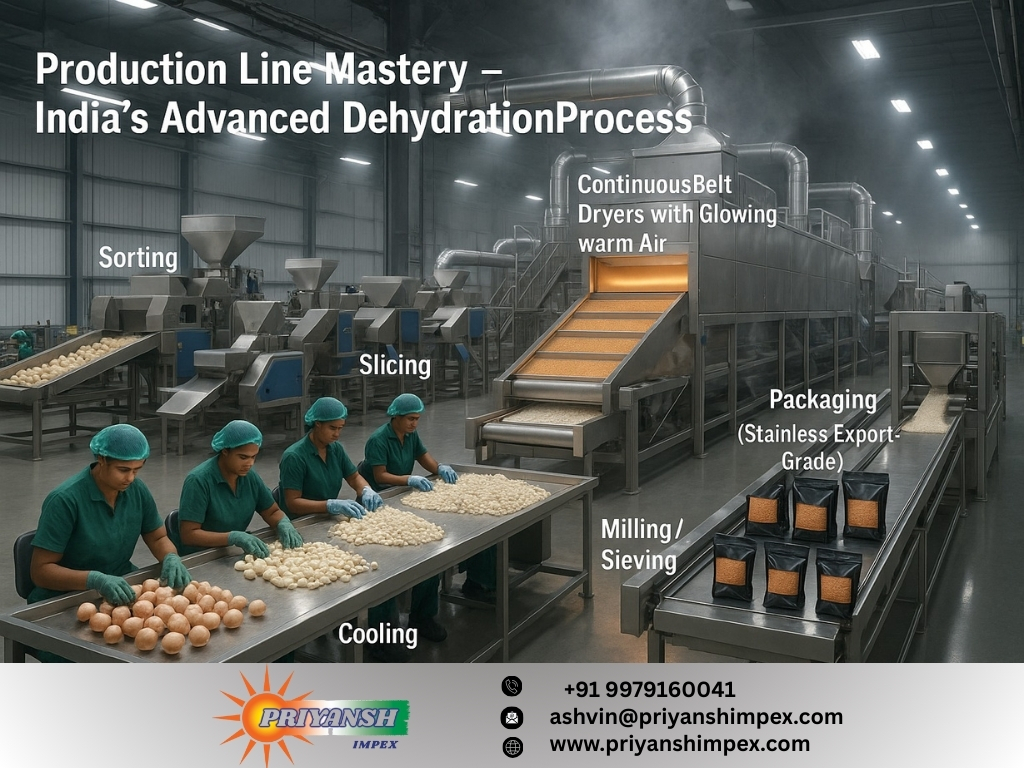
Unique Selling Propositions (USPs) – What Newness India Offers
Here are key features that make India’s dehydrated onion & garlic stand out:
- Production scale + supply reliability: With India being one of the largest producers of onion (especially states like Maharashtra, Madhya Pradesh, Gujarat) and garlic (Madhya Pradesh, Rajasthan etc) the underlying raw-material base is strong.
- Variety & customization: Indian processors can deliver chopped, granulated, flakes, toasted, white onion, red onion, garlic powder, garlic granules. This variety gives importers flexibility in formulation.
- Cost-competitiveness: Lower labour, material and energy costs in India mean favourable pricing—allowing importers in Russia, Brazil and Germany to improve margins or invest in value-adds.
- Traceability & certification readiness: Many Indian dehydration units (especially in Gujarat) are export-oriented, capable of international food-safety standards, meaning German importers (with stringent standards) or Brazilian/Russian importers can rely on this.
- Geographic advantage & logistics: States like Gujarat have well-developed ports (e.g., Mundra, Kandla) and connectivity to export which means faster turnaround and logistic reliability.
- Sustainability & value-add orientation: Some Indian plants are adopting more efficient dehydration technologies, cold chain, and lower energy consumption. For importers sensitive to “green” sourcing, this is an advantage.
- Opportunity for innovation: India can offer customized blends (e.g., onion-garlic premixes), specific cut sizes, toasted aroma profiles etc. This newness can differentiate your import offering in markets like Russia, Brazil & Germany.
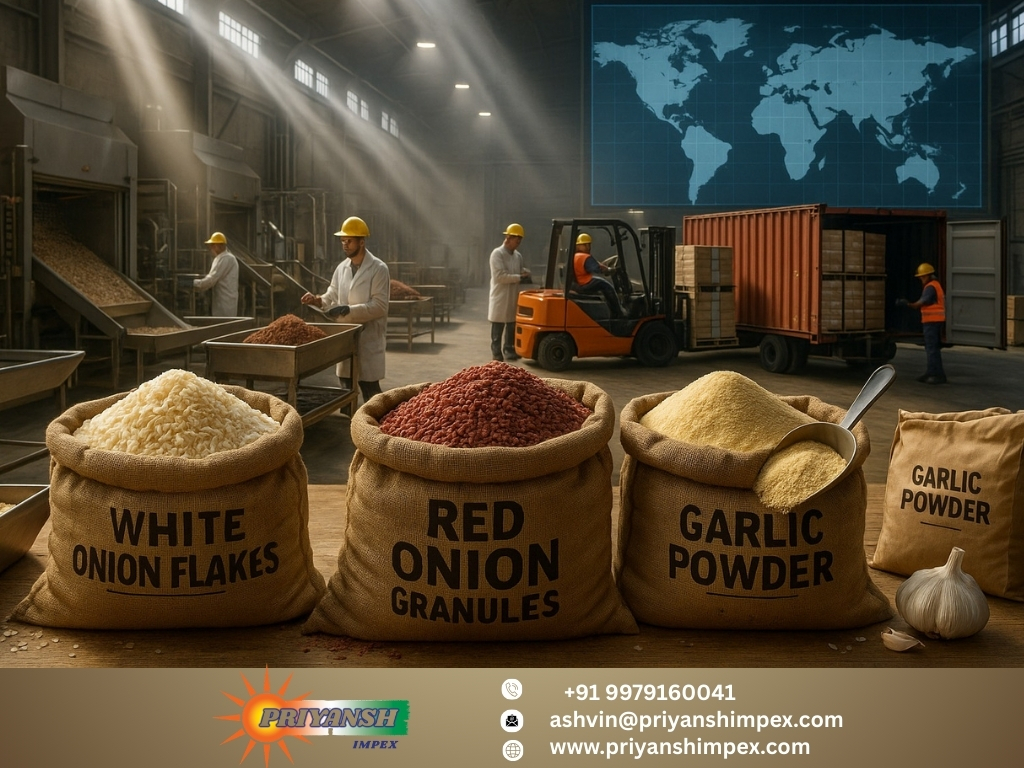
Top Product Varieties from India
- Dehydrated White Onion Flakes
- Specialty: Mild flavor, bright white color
- Ideal Use: Soups, sauces, ready-to-eat meals
- Sourcing Region: Bhavnagar and Mahuva (Gujarat)
- Dehydrated Red Onion Granules
- Specialty: Stronger aroma, rich natural red color
- Ideal Use: Snack coatings, spice blends
- Sourcing Region: Nashik (Maharashtra), Indore (Madhya Pradesh)
- Dehydrated Garlic Powder
- Specialty: Fine consistency, strong sulfur-rich aroma
- Ideal Use: Seasonings, marinades, food processing
- Sourcing Region: Neemuch, Ratlam (Madhya Pradesh), Baran (Rajasthan)
- Toasted Onion Powder
- Specialty: Enhanced roasted aroma, deeper flavor
- Ideal Use: Gourmet ready meals, spice mixes
- Sourcing Region: Export-grade units in Gujarat
- Garlic Minced or Granules
- Specialty: Coarse texture, high pungency
- Ideal Use: Pickles, sauces, fast food manufacturing
- Sourcing Region: Uttar Pradesh, Gujarat
- Blended Onion-Garlic Premix
- Specialty: Balanced mix, easy formulation
- Ideal Use: Instant noodles, bouillon cubes, seasoning packets
- Sourcing Region: Custom blending units in Gujarat and Maharashtra
- Organic Dehydrated Onion Flakes and Garlic Powder
- Specialty: Grown without synthetic pesticides or fertilizers; certified organic
- Ideal Use: Health-conscious, clean-label, and organic food product segments
- Certifications: USDA Organic, EU Organic, India Organic
- Sourcing Region: Madhya Pradesh, Maharashtra, Rajasthan (organic-certified farms)
- Toasted Garlic Granules and Flakes
- Specialty: Smoky, rich roasted garlic flavor with darker color
- Ideal Use: Gourmet seasonings, snack industry, premium condiments
- Sourcing Region: Gujarat, MP (units with roasting lines)
- Low Microbial Count Garlic and Onion Products
- Specialty: Heat-treated or irradiated for low microbial load
- Ideal Use: Pharmaceutical, nutraceutical, baby food applications
- Sourcing Region: Dedicated hygienic processing units in Gujarat and Rajasthan
- Custom Cut Sizes (Extra Fine to Coarse)
- Specialty: Tailored particle sizes for specific food applications
- Ideal Use: Ready mixes, sauces, dry rubs, dressings, processed foods
- Available in: Powder, minced, chopped, granulated, flakes
- Sourcing Region: Flexible processors in Mahuva (Gujarat), Nashik
- Onion-Garlic Herb & Spice Premixes
- Specialty: Blended with herbs (like parsley, oregano) for instant seasoning
- Ideal Use: Frozen meals, spice kits, seasoning sachets for B2B sales
- Sourcing Region: Value-added spice blend exporters in Gujarat & Maharashtra
- Non-GMO and Allergen-Free Certified Varieties
- Specialty: Certified non-GMO, gluten-free, allergen-controlled supply
- Ideal Use: European and North American health-food importers
- Sourcing Region: Compliant units with international certifications (ISO 22000, BRC)
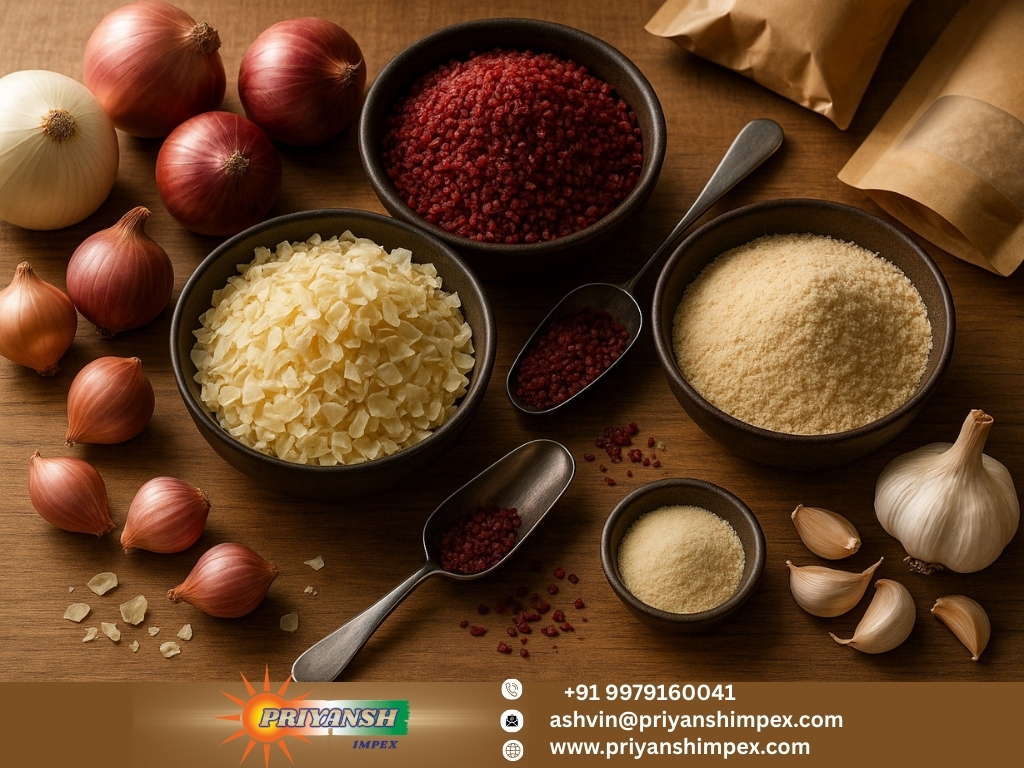
Export-Entry Strategy for Importers
If you’re an importer in Russia, Brazil or Germany considering sourcing from India, here’s a strategic approach:
- Supplier short-listing & audit
- Identify Indian dehydration plants (especially in Gujarat, MP, Rajasthan) with export experience, food safety certifications, and reliable logistics.
- Conduct a remote or on-site audit (or ask for third-party audit) focusing on processing, hygiene, heat/air-flow, moisture control, packaging.
- Sampling & evaluation
- Request multiple formats and send samples for your local processing lines. Evaluate cut-size, aroma, moisture, colour, functional behaviour in your end-use (e.g., seasoning blend).
- Quality specification agreement
- Create a detailed specification sheet (moisture ≤6%, aw <0.6, aroma retention, cut size uniformity, foreign matter <0.1%, packaging details) and include inside contract.
- Logistics planning
- Discuss export terms (FOB/CIF/DDU etc.), packaging for export, container loading, fumigation/ISPM15 requirements if needed, transit time to destination ports (Russia: e.g., via Mumbai - St Petersburg; Brazil: via Mundra - Santos; Germany: via Mundra/Kandla - Hamburg).
- Regulatory & customs compliance
- For Germany: Ensure compliance with EU food-import regulations, pesticide residues, E-numbers in blends, allergen labelling. For Brazil: compliance with Anvisa (Brazilian health regulator), import duties, possibly Mercosur trade terms. For Russia: Russian phytosanitary certification, language labelling.
- Build supply chain reliability
- Negotiate recurring shipments, maybe monthly or quarterly, and have buffer stock or alternate suppliers. Use logistics benchmarking (Indian ports like Mundra/Kandla have strong export infrastructure).
- Commercial & marketing support
- Work with Indian exporter to co-develop promotional collateral (e.g., Onion-Garlic flavouring blend brochure, technical sheet), provide joint webinars or factory visits for your team.
- Risk mitigation
- Use trade-financing tools (LC, DP/DA terms), contract escalation clause for volume/price, inspect containers pre-shipment, require transport insurance.
- Continuous improvement & product innovation
- As you import, share feedback back to the Indian supplier for improved cut sizes, transparent packaging, new pack sizes. Move from commodity into value-added variants.
Strategic Partnership Opportunities for Importers
- Private Labelling: Customize packaging for local branding.
- Joint Ventures: Co-invest in Indian units to ensure supply security.
- Exclusive Distribution: Become a regional distributor for an Indian dehydrator.
- Contract Farming: Tie-ups with Indian farms for traceable raw material sourcing.
Conclusion
India is not just a source, but a strategic partner for importing dehydrated onion and garlic. For importers in Russia, Brazil, and Germany, the value proposition is clear—unmatched variety, quality, customization, logistics efficiency, and regulatory compliance. By sourcing from India, importers not only secure cost-effective, high-quality ingredients but also gain a competitive edge in their local markets.
Tags: Import Dehydrated Onion and Garlic from India Trusted by Buyers more than 80 Countries